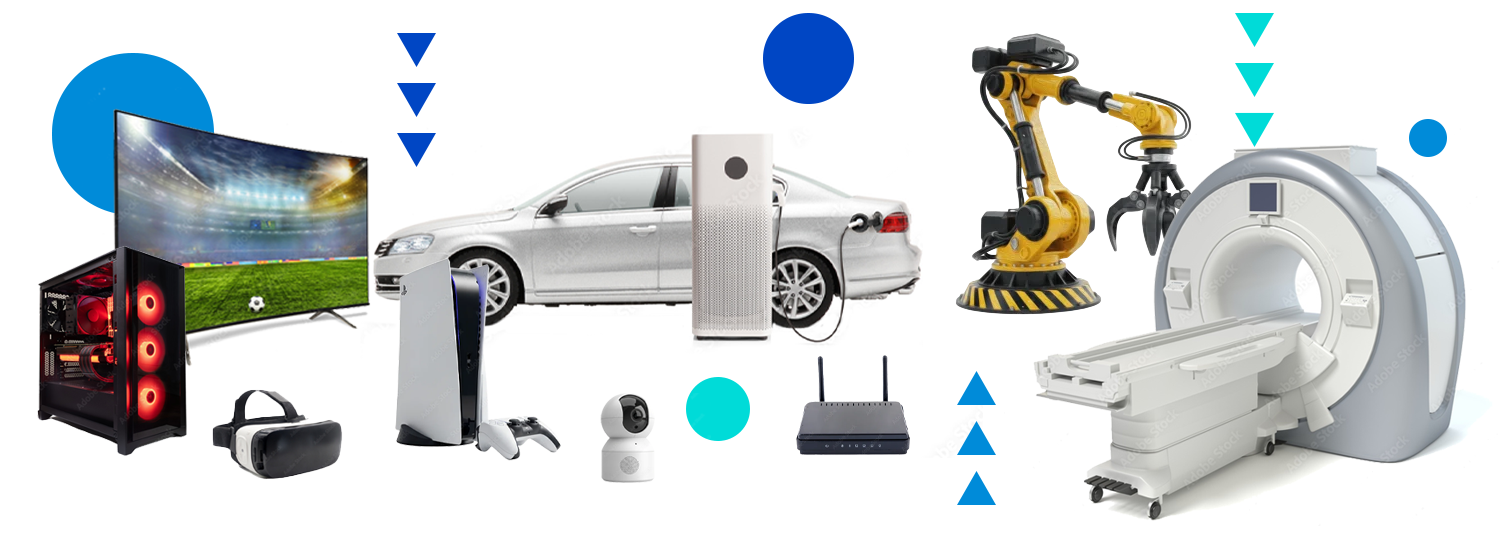
Semiconductors are ubiquitous in most of our daily lives. We may interact with thousands of chips throughout our day.
We mostly interact with semiconductors indirectly since they’re embedded in final products. For example, a modern car has up to 3,000 chips per car. These chips power features from environmental sensors and lighting systems to advanced driver assistance systems.
SIA and WSTS track semiconductor demand by end-use annual survey. The data reports semiconductor shipments across the following categories: PC/Computer, Communications, Automotive, Consumer Electronics, Industrial, and Government.
The table below captures some of the types of semiconductors used in the various end-use categories.
| End-Use Category | Semiconductors | Example products |
| Computers | CPUs, GPUs, memory, ASICs | PCs, servers, data centers |
| Communications | RF chips, baseband processors, transceivers | Smartphones, 5G infrastructure, routers |
| Consumer Electronics | Microcontrollers, SoCs, display drivers | TVs, gaming consoles, wearables |
| Automotive | Power ICs, sensors, microcontrollers, ADAS chips | EVs, autonomous driving systems |
| Industrial | Microcontrollers, sensors, power management ICs | Factory automation, smart devices, and appliances |