• Facebook
  • Twitter
  • YouTube
  • LinkedIn
  • WSTS Login
  • Contact
Skip to content
  • Home
  • About
    • Mission
    • History
    • Board of Directors
    • Members
    • Join SIA
    • SIA Team
    • Partner Organizations
    • SIA Jobs
  • SEMIS 101
    • What are Semiconductors?
    • Why are Semiconductors Important?
    • How have Semiconductors Evolved Over Time?
    • How are Semiconductors Made?
    • What are the End Uses of Semiconductors?
    • U.S. Industry Impact
  • Policy
    • Policy Overview
    • Policy Reports
    • Chip Incentives & Investments
    • Tax
    • Research
    • Chip Design
    • Trade
    • Export Control/Nat’l Security
    • Workforce & Immigration
    • Environment, Health & Safety
    • Supply Chain Security
    • Anti-Counterfeiting
    • Intellectual Property
    • Emerging Technologies
  • Market Data & Resources
    • Market Data
    • Resources
    • Policy Reports
    • 2025 State of the U.S. Semiconductor Industry
    • 2025 Factbook
  • News & Events
    • Latest News
    • Blog
    • SIA News Roundup
    • 2025 SIA Awards Dinner
    • Events & Webinars
    • Awards
    • Sign Up for SIA News
  • WSTS Login
  • Contact

What are Semiconductors?


Semiconductors are the chips that power modern electronics.

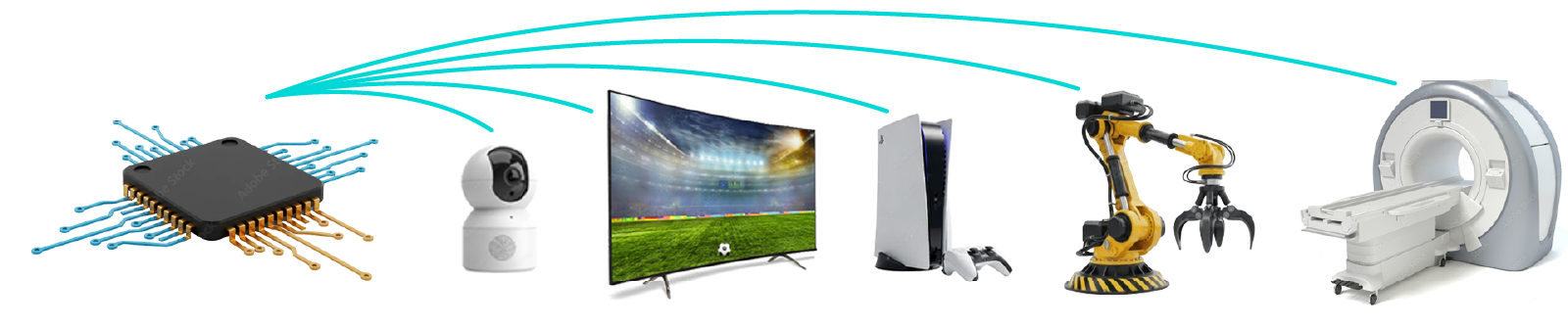
Virtually all electronic devices – smartphones, PCs, medical devices, defense systems, data centers, and countless others – contain semiconductors that enable them to process and store information, deliver power, and condition signal. In short, semiconductors are the building blocks of modern technology and the global digital economy.

Why are they called ‘semiconductors’?

They’re called “semiconductors” because they are made from materials with adjustable electrical conductivity. This characteristic allows us to create switches or other features without moving parts with sizes nearing the atomic scale. As a result, semiconductor manufacturing is among the most complex and capital-intensive processes in all of human history.

How do they work?

Semiconductors work by controlling the flow of electrons through networks of semiconductor devices (i.e., integrated circuits). Integrated circuits are made by exposing semiconductor wafers (i.e., silicon, compound semiconductors) to a variety of other metals and dopants to control electrical conductivity and build up devices (i.e., transistor). These “fabrication” processes yields many from a single wafer. Each die is cut, tested, packaged, and assembled before incorporation into final products.

Types of semiconductors

Semiconductor components can be grouped into six categories. It should be noted that some products may combine components from multiple categories. For example, a system-on-a-chip is logic device with analog and memory components.

  • Discrete: single electronic components that perform one basic electronic function. For example, a bipolar junction transistor controls the flow of enables or inhibits the flow of electricity in a circuit.
  • Optoelectronics: Semiconductor devices that either produce light or detect light.
  • Sensors & Actuators: Semiconductor devices that detect real-world signals or convert electricity into motion.
  • Analog: semiconductor devices that translate real-world signals—like sound, temperature, light, voltage—into digital data, or vice versa.
  • Memory: semiconductor devices used to store digital data or instructions, either temporarily or permanently.
  • Logic: Semiconductor devices that perform logical functions on digital signals to perform tasks like computation, control systems, or route signals.
End Uses

Semiconductors are the foundation of modern electronics, powering everything from smartphones and laptops to cars and medical devices. They are essential for computing, communication, and sensing technologies.

Beyond consumer devices, semiconductors enable advanced applications like artificial intelligence, renewable energy systems, aerospace, and defense technologies. They also play a critical role in data centers and cloud computing, supporting the global digital economy. In 2024, semiconductor shipments totaled $630.5 billion with over two-thirds going into computers and communications systems, which are growing rapidly due to compute demand. As technology advances, semiconductors are becoming even more integral to innovations such as autonomous vehicles, 5G networks, and quantum computing.

Detailed information on semiconductor sales by end-use, type, and regions are available in our annual End Use Survey.

1101 K Street NW Suite 450, Washington, DC 20005
E-mail

  • Facebook
  • Twitter
  • YouTube
  • LinkedIn
  • Sign up for SIA News

© 2026 Semiconductor Industry Association. All Rights Reserved.
  • Privacy Policy